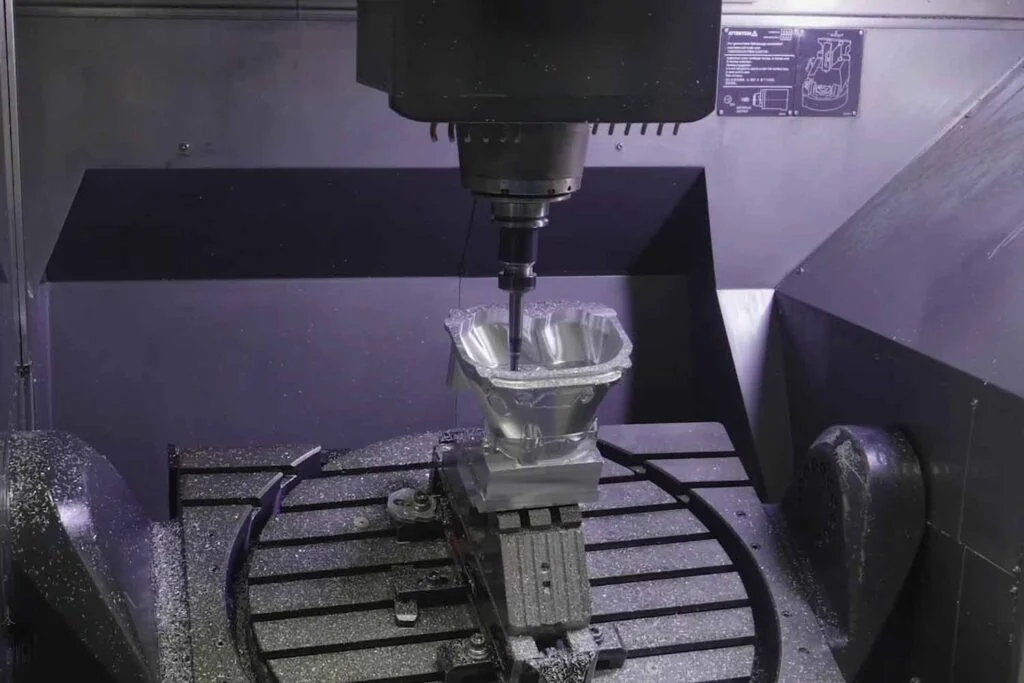
How many 5 axis machining parts do you know?
Nowadays, we generally have these 6 types of 5 axis machining parts: Automotive Engine Blocks and Cylinder Heads, Aerospace Components, Marine Parts, High-End Molds, Complex Artworks. Machines used in 5-axis machining are typically referred to as 5-axis machines or 5-axis machining centers. These machines can process different sides of a workpiece without changing its position on the machine, significantly improving the efficiency of machining complex parts. 5-axis machining centers are suitable for parts with complex shapes, especially those with curved surfaces, inclined surfaces, or unconventional geometries.
Advantages of 5-Axis Machining
Compared to 3-axis CNC machining, 5-axis CNC machining offers the following advantages for complex surfaces from both a process and programming perspective:
Improved Quality and Efficiency: Enhances the machining quality and efficiency of parts.
Expanded Process Range: Increases the range of processes that can be performed.
Meets New Development Directions: Supports the trend towards integrated and complex part production.
Enhanced Precision: Improves the precision of complex parts.
In deep cavity machining, 3-axis machining centers require extended tool holders and tools. However, 5-axis machining centers can shorten tool lengths by using additional rotation and tilting of the workpiece or spindle head. This prevents collisions between the tool, tool holder, and cavity walls, reduces tool vibration and damage, extends tool life, and significantly improves the surface quality and machining efficiency of molds.
For sidewall machining, a 3-axis machining center requires tool lengths greater than the sidewall depth. If the tool length exceeds three times the diameter, maintaining tool quality becomes challenging. A 5-axis machining center can tilt the spindle or workpiece, keeping the tool perpendicular to the mold’s sidewall, enhancing workpiece quality and extending tool life.
In 3-axis machining, ball nose end mills are used for fine milling paths, but the center rotation speed of the ball nose is almost zero, causing significant tool wear and reduced surface quality during mold machining. The application of 5-axis machining allows for machining at specific angles, increasing the relative linear speed, which not only extends tool life but also greatly improves the surface quality of the workpiece.
Suitable Types
5-axis machining centers are ideal for complex-shaped parts, particularly those with curved surfaces, inclines, or unconventional geometries. Common types of parts suitable for 5-axis machining include:
Automotive Engine Blocks and Cylinder Heads: High-precision machining of complex surfaces, suitable for automotive engine blocks and cylinder heads.
Aerospace Components: The aerospace industry often requires machining of complex components like turbine blades and intake guide vanes, which demand high precision.
Marine Parts: Complex ship structures require machining of various shapes, effectively handled by 5-axis machining centers.
High-End Molds: High-precision machining of molds, including injection and die-casting molds.
Medical Device Parts: Medical devices often require precision machining of intricate surfaces and small components, which 5-axis machining can efficiently achieve.
Complex Artworks: Capable of machining intricate artistic pieces such as sculptures and decorative items.
Conclusion
The advantage of 5-axis machining lies in maintaining an optimal angle between the tool feed direction and the workpiece surface for better surface quality and easier access to undercuts, while also extending tool life. It offers more economical tool use, reduced cycle times, and single-clamping setups, all contributing to time savings and reduced error rates in machine processing.