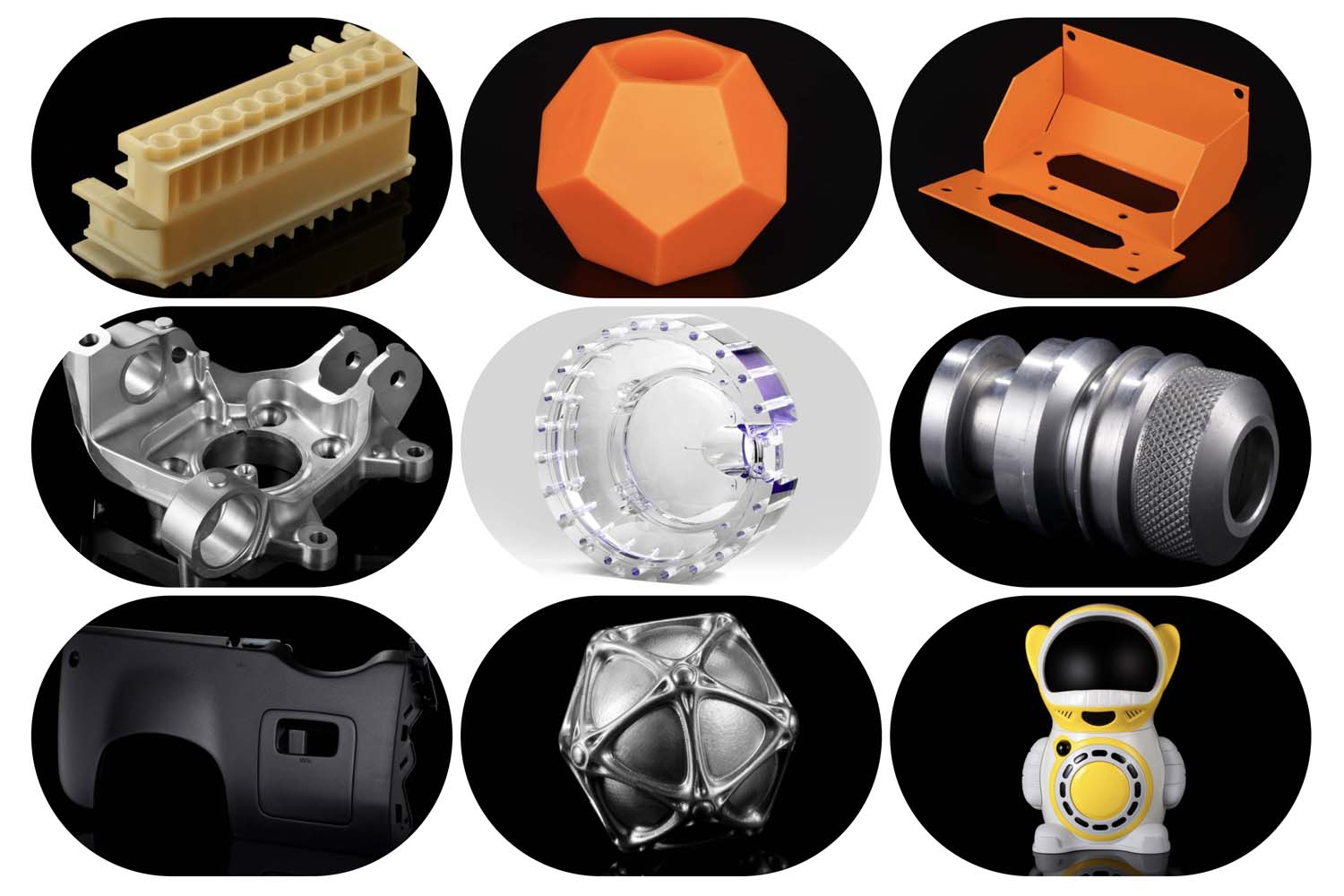

CNC Machining Applications in China A Strategic Overview for Global Manufacturers China has emerged as a global powerhouse in precision manufacturing, with CNC machining at the heart of its industrial success.
Quick answer
The strongest approach to CNC Machining Applications Across Industries is to match materials, tolerances, finishing, and inspection depth to the demands of each industry instead of treating all machined parts as technically equivalent.
At a glance
- Different industries change the route because they change the real risk.
- Match measurement and finishing plans to application-specific functional surfaces.
- Use the application to decide whether cost, speed, traceability, or finish is the governing priority.
Related service path
Review the CNC machining path, 5-axis machining path, and surface finishing path when mapping application requirements to process choices.
From aerospace components to medical devices and consumer electronics, the versatility and scalability of computer numerical control (CNC) technology have made it indispensable across industries.

瞭解 CNC machining applications in China is essential for procurement managers, product designers, and engineering teams seeking cost-effective, high-quality production solutions without compromising on precision or compliance.
This article explores key application areas, regional strengths, quality considerations, and how partnering with experienced local providers-such as Bole Solutions-can streamline sourcing and ensure consistent results.
Aerospace and Defense Components Demand Extreme Precision One of the most demanding CNC machining applications in China lies in aerospace and defense manufacturing.
Chinese suppliers increasingly meet international standards-including AS9100 and NADCAP-for producing structural brackets, engine housings, landing gear parts, and avionics enclosures.
These components require tight tolerances, exotic materials like Inconel, titanium alloys, and high-strength aluminum, and rigorous traceability.

Leading CNC facilities in Shenzhen, Suzhou, and Xi’an invest heavily in five-axis machining centers, in-process metrology, and certified quality management systems.
For global OEMs, this means access to competitive pricing without sacrificing certification integrity-especially when working with partners who maintain direct oversight of material sourcing, heat treatment, and surface finishing.
Medical Device Manufacturing Requires Regulatory Alignment The medical sector represents another high-growth CNC machining application in China.
Orthopedic implants, surgical instruments, diagnostic equipment housings, and minimally invasive device components all rely on repeatable accuracy and biocompatible materials such as stainless steel 316L, cobalt-chrome, and PEEK.
With China’s National Medical Products Administration (NMPA) tightening regulations-and many manufacturers pursuing FDA 510(k) or ISO 13485 certification-the ability to document every step of production becomes non-negotiable.
Suppliers with dedicated medical divisions often operate in cleanroom environments, maintain full revision control, and support design for manufacturability (DFM) reviews early in the development cycle.
This proactive collaboration reduces time-to-market and mitigates compliance risk-critical advantages when scaling from prototyping to full-volume production.
Automotive and Electric Vehicle Supply Chains Accelerate Innovation As China leads the world in electric vehicle (EV) production, CNC machining applications have expanded rapidly within powertrain, battery enclosure, and ADAS sensor housing manufacturing.
High-volume production of aluminum die-cast chassis components, motor stator housings, and custom cooling plates demands both speed and dimensional stability.
Advanced CNC shops integrate automated pallet systems, real-time tool wear monitoring, and statistical process control to sustain throughput while maintaining CpK values above 1.33.
Moreover, proximity to Tier 1 suppliers and EV OEMs enables rapid iteration cycles-making China an ideal location for pilot runs, functional testing, and low-volume validation before committing to long-term tooling elsewhere.
Consumer Electronics and Industrial Equipment Benefit from Scalability From smartphone camera modules to robotics end-effectors and semiconductor test fixtures, CNC machining applications in China thrive where complexity meets volume.
The country’s dense ecosystem of machine tool distributors, tooling specialists, and secondary service providers-such as anodizing, plating, and laser marking-enables end-to-end part completion under one roof.
Many factories in Dongguan and Ningbo specialize in micro-machining sub-0.1 mm features, multi-material assemblies, and tight cosmetic finishes required by premium brands.
Importantly, these capabilities are now supported by digital infrastructure: cloud-based MES platforms, remote inspection reporting, and shared project dashboards help international clients monitor progress transparently-even across time zones.
Why Partnering with a Trusted Local Representative Matters While China offers unmatched capacity and capability, navigating its manufacturing landscape presents challenges.
Language barriers, inconsistent documentation practices, variable quality discipline across tiers of suppliers, and logistical coordination can derail even well-planned projects.
That’s where specialized partners like Bole Solutions add measurable value.
With over a decade of experience supporting North American, European, and APAC-based clients, Bole Solutions operates as an extension of your engineering and procurement team-not just a middleman.
They conduct on-site audits using standardized checklists aligned with ISO 9001 and IATF 16949, manage supplier selection based on technical fit rather than lowest bid, and oversee first-article inspections with calibrated CMM reports.
Their engineers collaborate directly with your design team to resolve DFM issues before quoting, reducing costly redesigns downstream.
Most importantly, Bole Solutions maintains long-standing relationships with pre-vetted CNC facilities-many of which they helped upgrade equipment, train staff, and implement lean workflows-ensuring continuity and accountability across order cycles.
Sustainability and Future-Ready Capabilities Are Increasingly Central Beyond traditional metrics, forward-looking buyers are evaluating CNC machining applications in China through lenses of sustainability and digital readiness.
Leading suppliers now report energy consumption per part, utilize closed-loop coolant systems, and pursue carbon-neutral certifications.
Simultaneously, adoption of Industry 4.0 tools-predictive maintenance algorithms, digital twins for process simulation, and AI-driven quality analytics-is rising among top-tier shops.
Bole Solutions actively benchmarks these advancements and guides clients toward partners whose technology roadmaps align with their own innovation timelines.
Conclusion CNC machining applications in China span mission-critical sectors where reliability, repeatability, and responsiveness converge.
Whether you’re developing next-generation medical hardware, lightweighting EV structures, or launching a high-mix consumer product line, leveraging China’s mature CNC ecosystem strategically delivers tangible ROI.
Success hinges not on geography alone-but on informed partnership.
Working with a seasoned, technically grounded representative like Bole Solutions bridges the gap between global expectations and local execution.
They bring clarity to complexity, consistency to variability, and confidence to every component you bring to life.
For organizations committed to quality, speed, and scalability, integrating China’s CNC machining capabilities-guided by trusted expertise-is no longer optional.
It’s essential.
Industry requirements change the machining route
CNC Machining Applications Across Industries becomes much more useful when the process is discussed in the language of the end industry. Medical, automotive, industrial, robotics, and aerospace parts all value different combinations of traceability, cosmetic quality, cycle time, material pedigree, and repeatability.
That means the same nominal machining capability can lead to very different routes depending on where the part will be used. Material selection, fixture risk, and downstream treatment have to be tied back to the application itself.
Linking application risk to process and finishing choices
A mature machining plan identifies which faces matter for sealing, alignment, fatigue, wear, or appearance and then matches inspection and finishing to those features. This prevents over-processing low-risk areas while protecting the ones that actually decide product performance.
Bole Solutions is most useful when application risk is translated into DFM and process planning early. That is what makes CNC Machining Applications Across Industries a strategic manufacturing choice instead of a generic service label.